Not another habit tracker.
The only one where your friends see you fail.
“Why do I always quit around week three?”
You've started eleven times. What's actually missing?
You're asking yourself…
You could recite the advice in your sleep. Move your body. Sleep earlier. Read the book on the nightstand. You're not confused. You've never been confused.
You've downloaded the trackers, filled in the little squares, built the Notion template on a Saturday.
You watch friends who are less disciplined than you somehow keep going, wondering: “Why not me?”
You start on a Sunday with total conviction and you're gone by Thursday, every time.
The habit trackers. Not one, a dozen: the one with the streaks, the one with the little squares, the one your friend swore by, the one you actually paid for. The paper notebook, bought on a Sunday, beautiful, three pages used. The wall calendar with the crosses. The spreadsheet with the conditional formatting. The Notion template you spent a Saturday building instead of doing the thing, and opened four times. The 5am alarm. The accountability partner who stopped replying by week two. The books, Atomic Habits twice, the one about willpower, the one about the morning routine. The reminders you now swipe away without reading. The gym membership. The new year, the new month, the new Monday, the “this time it's different” that you meant every single time.
None of it held. Not one.
You're the only witness to your own promises, and you're an easy witness to fool.
Nobody notices the day you skip. So the day you skip costs you exactly nothing.
Every system you've tried was built on the same silent bet: that on a grey Tuesday in November, alone and tired, you'd beat yourself in a fair fight.
What if the problem was never your discipline?
What if you just needed someone to be watching?
The friend waiting at the trailhead at 7am.
The teammate who'd notice your empty spot.
The person you told, out loud, that you were quitting smoking this time.
Your rituals are visible to your league. Skip a day and it shows up on a list your friends are already looking at.
Anyone proposes a subject, everyone votes. Nobody hands you a template built for someone else's life.
You write “run 3km” or “read 10 pages”, and you pick which days you commit to. Honest beats heroic.
A streak makes each new day pay more than the one before. Showing up compounds instead of resetting.
Miss a day you committed to and your score goes down, in front of everyone. It's the first time quitting has ever cost you anything.
You're not accountable to a notification. You're accountable to people with names who are doing the same thing on the same days.
It's not an infinite grind. The standings freeze, somebody is champion, and you all start again.
One six-letter code, your people, nobody else. No feed, no strangers, no audience.
No ads, no tracking, no analytics library buried in the app. The only people looking at your days are the ones you invited.
Humans are a social species, and we behave completely differently when someone is watching. Not because we're weak, but because for most of our history, being seen by your group was the difference between belonging and being alone.
What gets repeated is what feels satisfying, and what stops is what carries an immediate cost. A habit that costs nothing to break is a habit you'll break.
Before the tired version of you gets a vote.
Not to an app. To people with names.
Visibly, in front of the people whose opinion you actually care about.
Somewhere in there, without deciding to, you became someone who runs on Tuesdays in November.
Your league is one code away.
Take one ritual worth 12 points. A 3km run, three days a week.
Day one pays 12.
Every day you keep the chain alive adds ten percent of that value on top of the next one. Day five pays 16. Day eleven pays 24, exactly double what day one paid. Same run. Same legs. Same weather.
Keep that chain alive for ninety days and you don't bank 1,080 points, which is what ninety flat days would give you. You bank around 5,900.
Now the other direction. Miss one Tuesday on day sixty and you lose six points, half of what the ritual was worth. That's the small part.
The big part is that your streak goes back to day one. The two months of multiplier you built evaporate, and tomorrow's run is worth 12 again.
That's why people don't skip. Not because the app nags them. Because they can see exactly what a Tuesday costs.
You don't get there by doing exceptional things.
You become irregular by being regular.
See what ninety days actually adds up to.
You make one, the app gives you a six-letter code, you send that code to your group chat. Anyone who types it in is now in your league. Yours is whatever size you make it. It's private. Nobody else can see it.
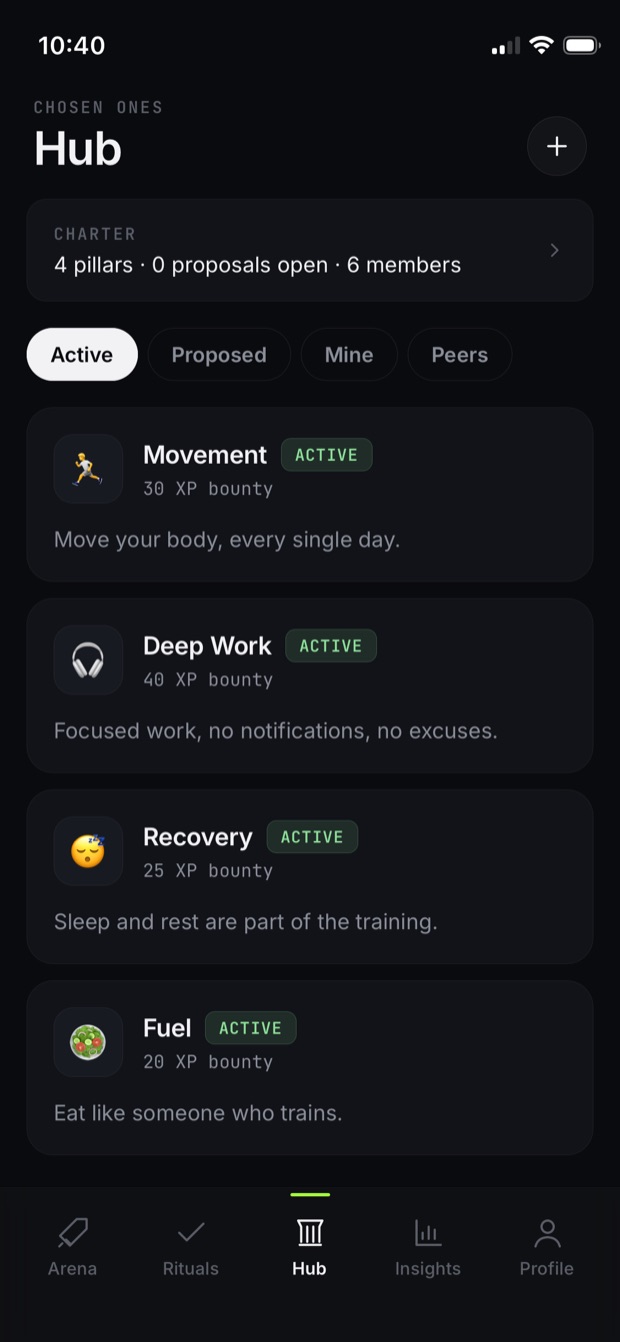
Sport. Sleep. Reading. Eating well. Anyone can suggest one, and the others vote yes or no. If enough people say yes, it becomes one of your league's subjects. The rules of your league are written by your league, not by me.
Under “Sport”, your ritual might be run 3km. Under “Reading”, read 10 pages. You write your own, in your own words. Sarah writes hers, and they're nothing like yours. You also choose which days of the week you're committing to — promising to run every single day when you know you won't is how this fails.
That's the whole daily action. Ten seconds. Ticking something gives you points — the app calls them XP. It's just a number that says how much you showed up.
Tick the same ritual several days in a row and each extra day makes the next one worth more. Day one pays its normal value; by day ten that same 3km run is paying you double. And if you skip a day you promised, you lose half of what that ritual was worth. Your score can go down. That's the entire point — it's the first time skipping has ever cost you anything.
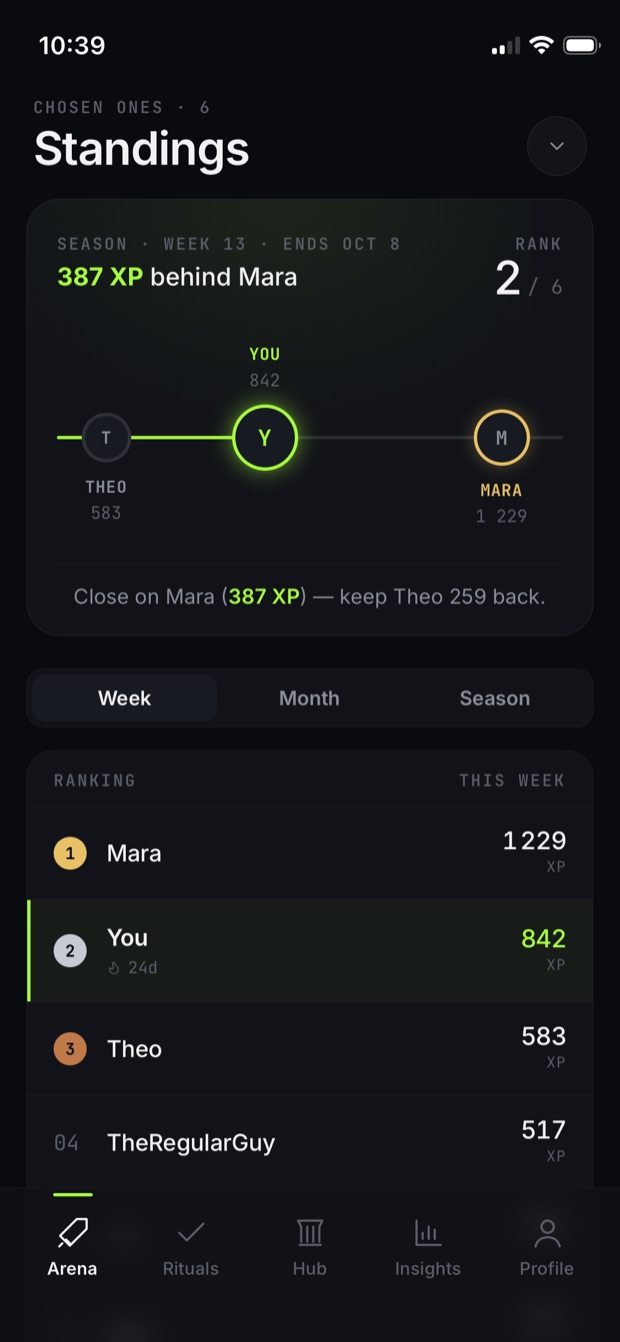
Everyone's points go into it, in front of everybody. Your friends don't need to check on you — they just see the list. After a few weeks the season ends, the standings freeze, whoever has the most points is the champion, and you all start again.
Ten seconds a day after that. Open the app in the evening, tick what you did, close it.
No templates, no onboarding quiz, no coach. You, your friends, and a list.
Your league exists as soon as one other person types the code.

Your league's standings, updated the moment someone ticks a box.

Propose a pillar, vote on your league's rules. The app belongs to the players, not to me.

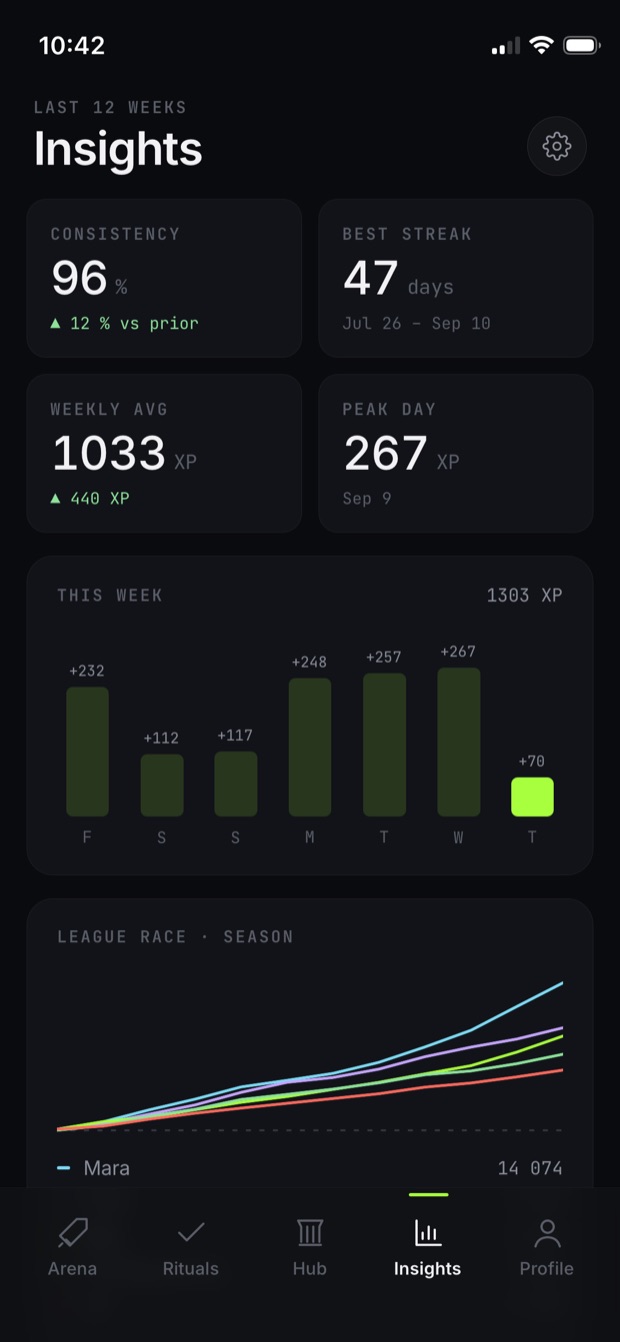
Twelve weeks of your days, as a map and a curve. Hard to argue with.
Habit League is a paid app. You can walk through every screen before paying. You just can't play.
Free had to pay for itself somewhere, and the usual places are ads sold against your discipline, or data collected about it. Neither of those belongs anywhere near the thing you're trying to fix about your life.
But that's not the real reason, and the real reason is the whole app.
This entire thing runs on one idea: a promise costs nothing until it costs something. You lose points when you skip a day, because losing nothing is exactly why you quit last time. Take the cost away and you're back to a tracker nobody is watching.
Paying is the first version of that cost. It's the one thing you put on the table on Sunday, while you still mean it, before the tired version of you on Thursday gets a vote.
Economists have a name for this. A commitment device is something you do today for the sole purpose of making it harder to quit tomorrow. The smokers in that trial weren't more disciplined than anyone else. They had simply made quitting expensive for themselves, in advance, on purpose.
It isn't a wall in front of the app. It's the first rep.
For years I read about habits and stayed exactly where I was. I had the Notion templates, the books, the theory. I could explain habit loops to you. I still quit everything after two weeks.
Then I became a father, and time stopped being something I had.
I went back to Atomic Habits and found one idea I had read years earlier and never actually used: a promise is stronger when you make it in front of someone.
So I stopped looking for a better app and asked four friends to do it with me. That worked. That's the only thing that ever worked.
Habit League is that, turned into an app.